

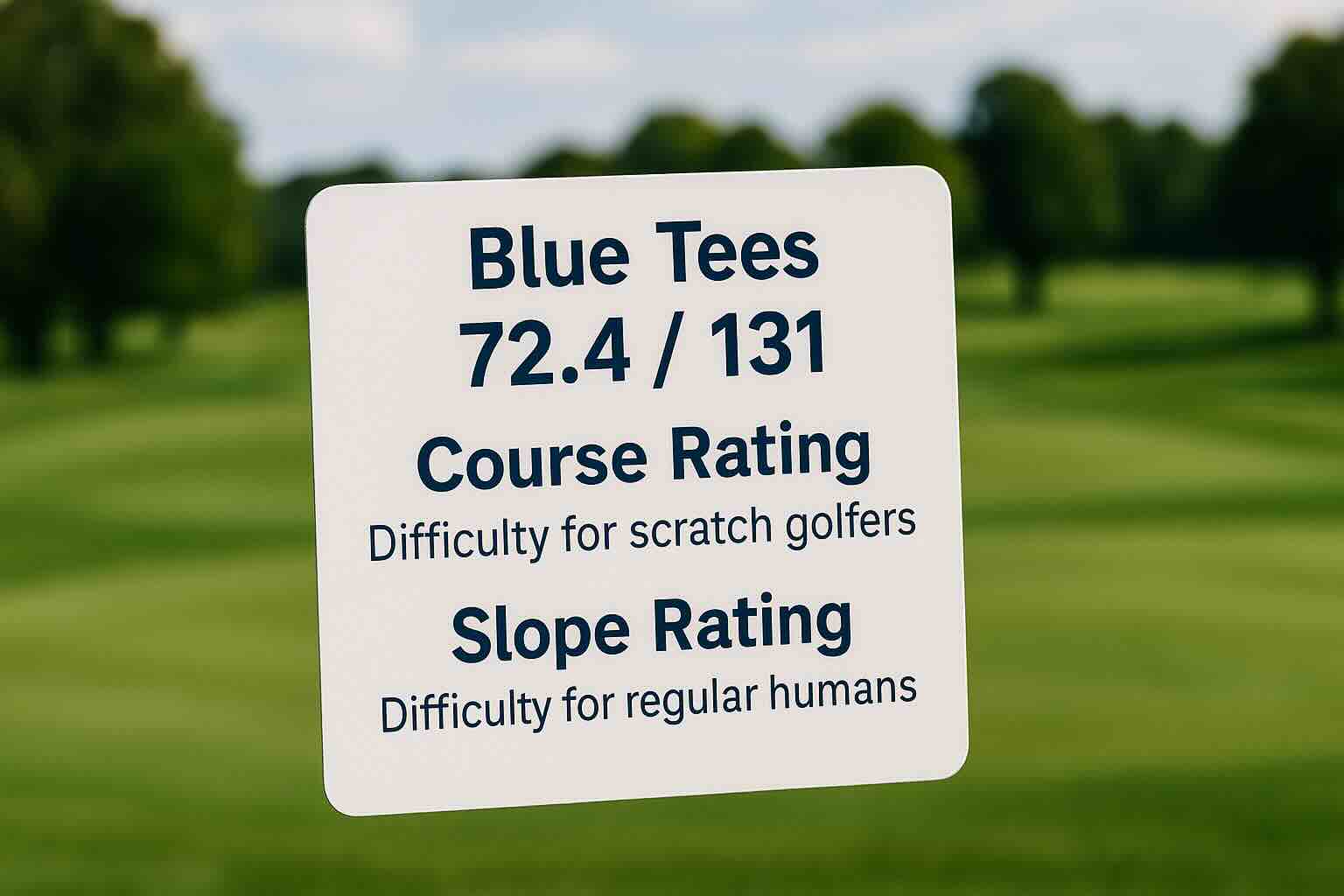
You show up to the course, glance at the scorecard, and see something like:
Blue Tees – 72.4 / 131
Cool. But unless you moonlight as a USGA official, you’re probably thinking… what do I do with that info?
Let’s break it down the Golf TotalGuide way — no jargon, just the stuff you need to know before you tee off (and definitely before you blame the course for your triple on 4).
What’s a Course Rating?
Course Rating is basically:
“What should a scratch golfer shoot on this course if they’re playing well?”
So if a course has a rating of 72.4, it means a scratch golfer (handicap of 0) should shoot 72.4. That’s it. It’s based on yardage, hazards, green speed, elevation — all the ways a course makes you sweat.
Think of it as the par score for someone who never hits it fat and never forgets to bring a towel.
What’s a Slope Rating?
Slope Rating answers the question:
“How much harder is this course for the rest of us?”
A Slope Rating of 113 is considered average. Most courses fall somewhere between 120 and 140. The higher the number, the more the course punishes bogey golfers — aka the 90-shooters, weekend warriors, and anyone whose short game occasionally disappears without warning.
So if the slope is 131, expect some trouble if you’re not striping it. Which, let’s be honest, is most of us.
How Do They Come Up With These Numbers?
They don’t just guess — trained USGA rating teams walk the course and evaluate:
- Length from every tee box
- Fairway width and where your ball’s likely to land (aka the weeds)
- Hazards: water, bunkers, trees, etc.
- Green complexity: fast? sloped? nightmare fuel?
- Overall difficulty for both scratch and bogey golfers
Each tee gets its own rating, because playing from the tips is a different game than the senior tees. (We see you, gold tee champions.)
Why It Matters for Your Handicap
Those numbers help calculate your Handicap Index, which keeps things fair across different courses. It’s how you can shoot 88 at one place and 92 at another — and still know which one was “better.” (Answer: the one with breakfast sandwiches at the turn.)
The short math looks like this:
(Score – Course Rating) × 113 / Slope Rating = Handicap Differential
No need to memorize that — just know the numbers help level the playing field.
Bottom Line for Golfers:
- Course Rating = Difficulty for scratch golfers
- Slope Rating = Difficulty for regular humans
- Higher numbers = Bring more golf balls
So the next time you check the card and see 72.4 / 131, now you know: it’s not just a bunch of numbers — it’s the course quietly warning you, “Good luck out there.”
Golf TotalGuide is on the App Store — course matching, hole-by-hole plans, and an Apple Watch rangefinder for 360+ publicly accessible courses across New England. One month free.